If your building has vacant space,
your roof can still produce income.
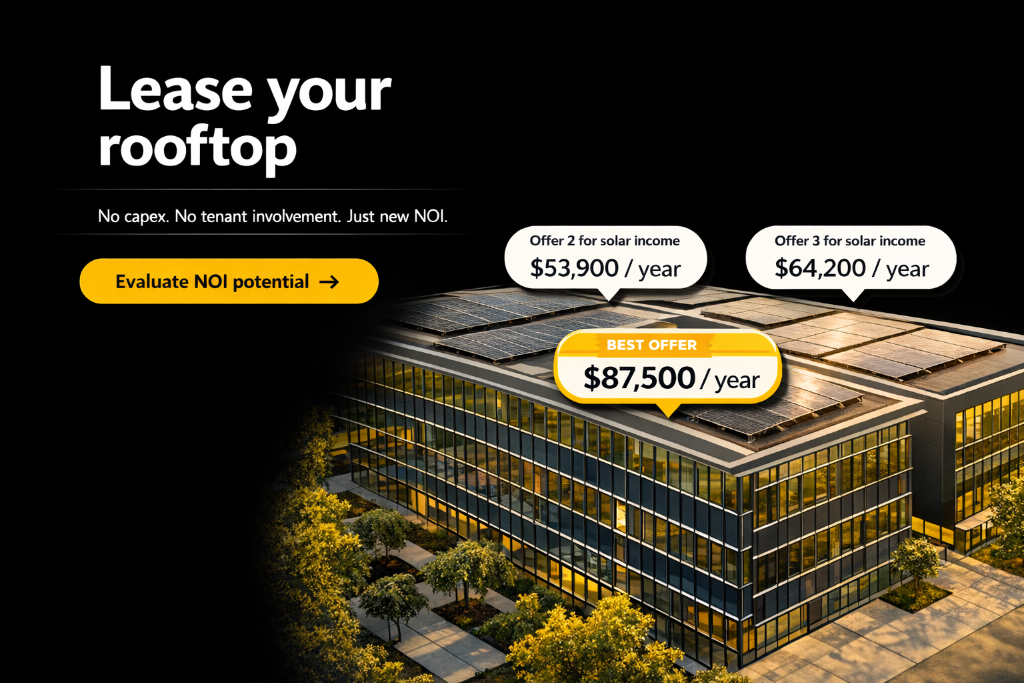
Turn unused roof space into 20+ years of fixed annual income-no capital, no tenants required. We represent property owners to secure competitive, owner-favorable lease terms.
The Problem We Solve
Going direct to a developer leaves income and property rights on the table.
A solar developer represents their project. We represent your property. Without competing offers and an advisor on your side, the lease is written in their favor - and you never learn what your roof was really worth.
One Offer, Their Terms
A single developer hands you one lease written in their favor. No market validation, no leverage, no one reviewing the documents on your side.
Unprotected Property Rights
Roof access, re-roofing obligations, insurance, assignment, and termination rights get buried in complex documents no advisor reviews for you.
No Rate Benchmark
Without competing offers you never learn whether the lease rate is fair for your roof size, utility territory, and interconnection economics.
Interconnection Surprises
CT and MA have complex utility approval processes. A deal can collapse late if interconnection feasibility and costs aren't assessed early by someone who knows the markets.
How Roof Lease Value Is Built
Three things determine what your roof is worth to a developer.
Strip away the noise and a solar roof lease comes down to three building blocks - each one a place a direct developer pitch leaves value on the table.
The Roof
Size, structure, shading, orientation, and remaining roof life. The physical asset that determines what scale of system - and income - your property can support.
The Deal
Lease vs. host PPA vs. community solar. Each structure has different economics, obligations, and the developer terms we negotiate in your favor.
The Market
CT SCEF / NRES and MA SMART programs, utility territory, interconnection capacity, and developer competition - what sets the rate your roof actually commands.
We solve this at the source - owner-side representation in a 20-year real estate agreement.
Create New NOI From An Underused Asset You Already Own
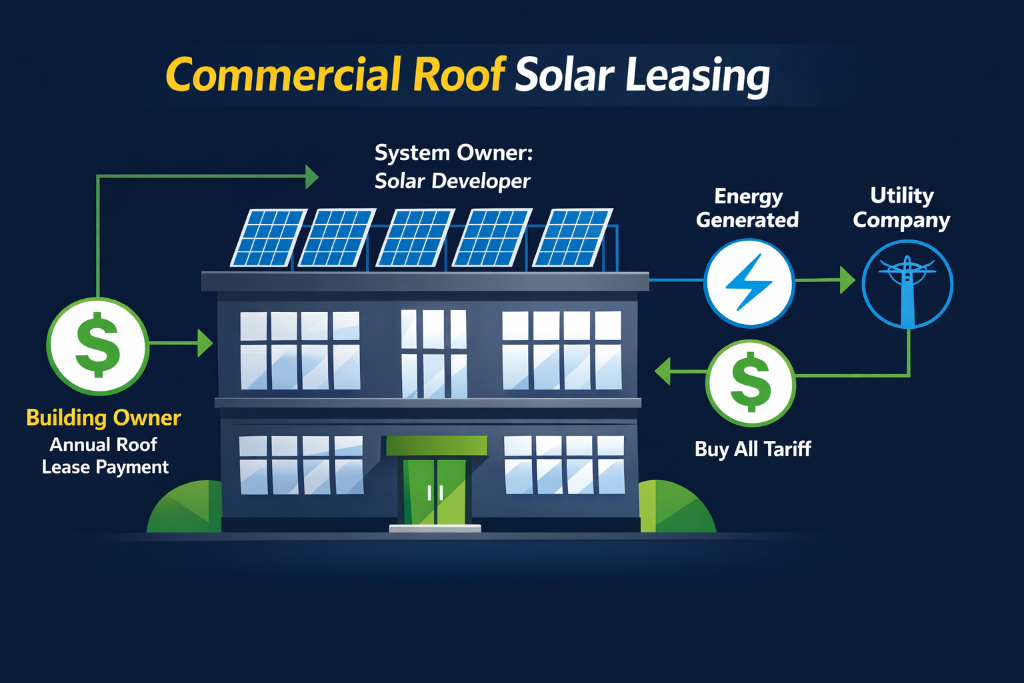
Lease unused roof space to vetted developers - they handle everything. You collect fixed annual payments.
No capital, no tenants, no occupancy risk. Pure NOI from an asset that's sitting empty.
Stabilize Cash Flow Despite Vacancies
Fixed annual payments for 20+ years-unaffected by tenant vacancies, slower leasing cycles, or market conditions. Your roof works even when your building is partially empty.
Zero Capital Required
Developer pays for all installation, permits, interconnection, maintenance, and insurance. You contribute nothing upfront-just unused roof space.
Unlock Hidden Value in Your Property
Create $55K–$85K+ annual NOI and add $900K–$1.4M+ to property value-no tenant buildouts, no lease negotiations, no occupancy risk required.
Roof Replacement Options
Many developers will replace aging roofs as part of the deal, often as an upfront replacement or a credit against early lease payments.
Stabilize Income Even With Vacant Space
Solar roof leases create pure NOI-no tenants, no TI spend, no concessions.
Income flows regardless of building occupancy. A 100,000 ft² roof generates $55K–$85K+ annually (CT/MA), adding $900K–$1.4M+ in property value at a 6% cap rate.
Eversource (CT)
UI (CT) similar rates
100k sq ft roof (~1 MW DC), $0.55+/sq ft/year
Eversource (MA)
Massachusetts territory
100k sq ft roof (~1 MW DC), $0.85+/sq ft/year
Understanding the Math
Solar roof leases generate fixed annual payments for 20-25 years-pure NOI with zero operating expenses. This recurring income stream directly impacts property valuations through standard cap rate calculations.
Roof-to-system ratio: Industry standard is approximately 100,000 sq ft per MW (DC) of solar capacity. Larger roofs support proportionally larger systems and higher payments; smaller roofs scale accordingly.
Market variability: Rates shown are based on Station A Marketplace data (2025) for community solar lease structures. Actual rates depend on roof size, utility territory, interconnection costs, developer competition, and state program economics. Your property's specific economics will vary based on these factors.
Developer vs. Owner Representation
A solar developer represents their project. We represent your property.
No capital. No tenants. No risk. We create competition among vetted developers and negotiate owner-favorable terms - success-based fee only upon executed lease.
Direct Developer Outreach
- •Single developer, single offer
- •Terms written in developer's favor
- •No market validation of lease rate
- •Limited negotiating leverage
- •Complex documents, no advisor review
Owner-Side Representation
- Structured RFP to multiple vetted developers
- Side-by-side proposal comparison
- Competitive tension for better rates
- Lease negotiation protecting property rights
- Real estate advisor throughout 20+ year commitment
How It Works
Does Your Roof Qualify?
We pre-vet sites to ensure strong developer interest and viable project economics.
Key factors: adequate roof space (10,000+ sq ft), good structural condition, 15+ years remaining roof life, and favorable utility interconnection in CT or MA.
Location
- Property in Connecticut or Massachusetts
- Favorable utility territory (Eversource, National Grid, UI)
- Accessible interconnection capacity
- Near populated areas for offtake value
Roof Requirements
- Typical range: 10,000–150,000+ sq ft usable
- Industrial, warehouse, or big-box commercial
- Low slope, minimal shading, south/west facing preferred
- 15-20+ years of useful life remaining
Site Characteristics
- Clear title and property rights
- Structural capacity for solar load
- Cooperative property owner
- Clean access for installation and maintenance
Roof Size & Deal Types
75,000–150,000 sq ft usable (Prime for Community Solar/Lease)
Typical scale: 600 kW–1.25 MW. Easiest to structure, finance, and match with developers. Strong lease economics.
10,000–75,000 sq ft usable (Viable for Lease or Host PPA)
Typical scale: 300–600 kW. Still attractive to developers, especially with favorable interconnection and strong offtake.
15,000–40,000 sq ft usable (Best for Host PPA)
Typical scale: 125–300 kW. More suitable for behind-the-meter use if building has steady daytime load (manufacturing, cold storage, retail).
What Kills Deals Faster Than Size
Even a giant roof can be a "no" if interconnection is constrained, structural capacity is insufficient, roof life is under 10 years, or shading/obstructions reduce usable area. The biggest constraint isn't roof availability-it's interconnection capacity and costs.
CT and MA have complex utility approval processes that can make or break project economics. We work with developers who understand these markets and can assess interconnection feasibility early, saving everyone time.
How It Works
From qualification to lease payments - we guide you through every step.
A competitive, transparent process that puts property owners in control of a 20+ year commitment.
We assess your roof's viability first.
Submit your roof details through our qualification form. We assess size, location, utility territory, and basic suitability - eliminating non-viable sites upfront.
- Roof size and structure reviewed
- Utility territory assessed
- Basic suitability confirmed
Market Context
Why CT & MA Markets Work
Connecticut Programs
CT supports solar through Shared Clean Energy Facilities (SCEF) for community solar (100 kW–2 MW) and NRES with ongoing procurement targets.
Massachusetts Programs
MA runs SMART 3.0 with active community solar pathways. One of the most developed distributed solar markets in the U.S., though interconnection requires expert navigation.
The Interconnection Challenge
Both states have complex interconnection processes with long timelines. Developers pay for studies and upgrades, but projects don't proceed if costs are prohibitive. Early feasibility assessment is critical.
Frequently Asked Questions
The questions building owners ask before leasing their roof.
Turn your unused roof into 20+ years of fixed income.
Owner-side representation, competitive developer offers, and owner-favorable lease terms - at no upfront cost.